


Welcome to the July 2026 Newsletter. This month, we’re discussing the economy, employment, financial terminology, and more.
Summary
THE ECONOMY
The economy is doing quite well with employment strong, inflation rolling over and sentiment increasing. First quarter 2026 GDP was significantly higher than fourth quarter 2025 GDP and initial unemployment claims are significantly below the level that would indicate a pending recession. The economy is showing a green light.
THE STOCK MARKET
The stock market is approaching its all-time closing high due to very high corporate profits and momentum in the tech sector. For the S&P 500 Index, the all-time closing high was 7,609.78 on June 2, 2026. For the Nasdaq, it was 27,093.90 on the same date. If we fail to break through these highs and turn back down, that will show a double top, and it could get scary if the market continues to slide lower. The stock market is showing more of a yellow light than a green one.
We have more stock market information throughout the newsletter below.
Quote of the Day
No matter how old we get, we should always continue our quest for personal growth. Dave Ramsey spoke on this topic on June 1, 2026 during his radio show, saying we should all continue to grow in:
Thankfulness – We cannot feel bitter about what we lack when we are focusing on the abundance we have. Gratitude cures envy.
Humility – We should recognize that our success and blessings are not entirely our own doing. Humility cures arrogance.
Contentment – When we are thankful and humble, we no longer feel the constant, exhausting need to chase more to feel worth. Contentment cures anxiety.

Second Quote of the Day
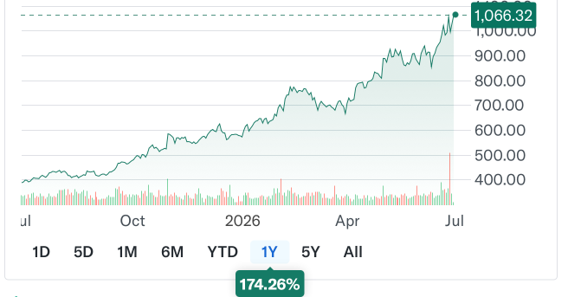
The one-year chart below of Caterpillar stock shows a 12 month return of 174%. This reminds me of the old Wall Street saying, “Bull and bears make money, but pigs get slaughtered!”
The following Caterpillar insiders have sold Cat stock in 2026.
- Anthony Fassino, Group President
- Rodney Shurman, Group President
- Jason Kaiser, Group President
- Andres Bonfield, Chief Financial Officer, Emeritus
- William Schaupp, Chief Accounting Officer
- Christine Pambianchi, Chief HR Officer
- Derek Owens, Chief Legal Officer
It’s highly likely this is a very good time for Cat stock owners to sell.
Pop Quiz
How many companies can you name that are currently testing driverless taxis in the US? Hint: there are seven.
The answer to this month’s Pop Quiz is at the bottom of the newsletter.
The Economy
Employment
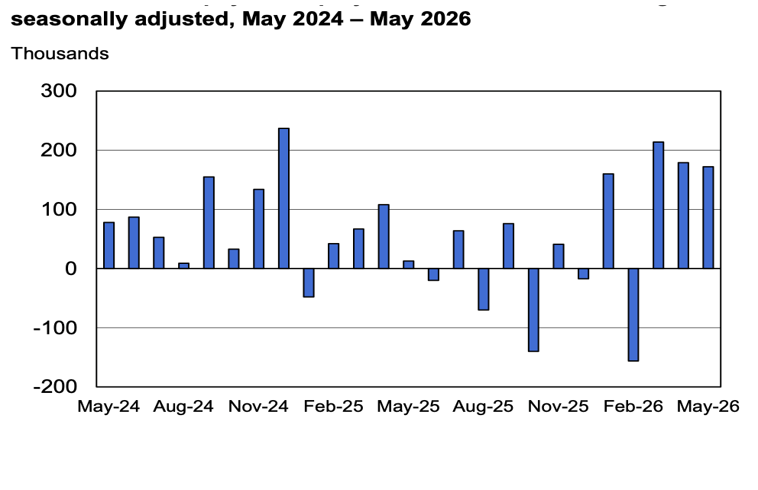
Total U.S. nonfarm payroll employment increased by 172,000 in May. The official unemployment rate, U-3, was unchanged at 4.3%. The March and April 2026 combined employment numbers were revised higher by 93,000 than previously reported. These are very positive numbers for the US economy.
Chart 1 below is based on the Bureau of Labor Statistics official unemployment rate, U-3.
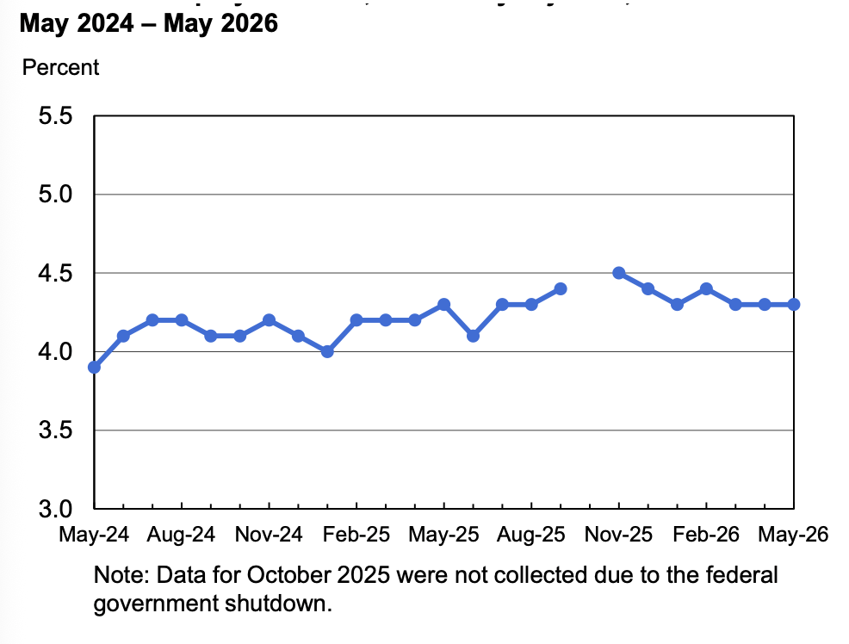
Chart 2 below shows the two-year trend of employment growth.
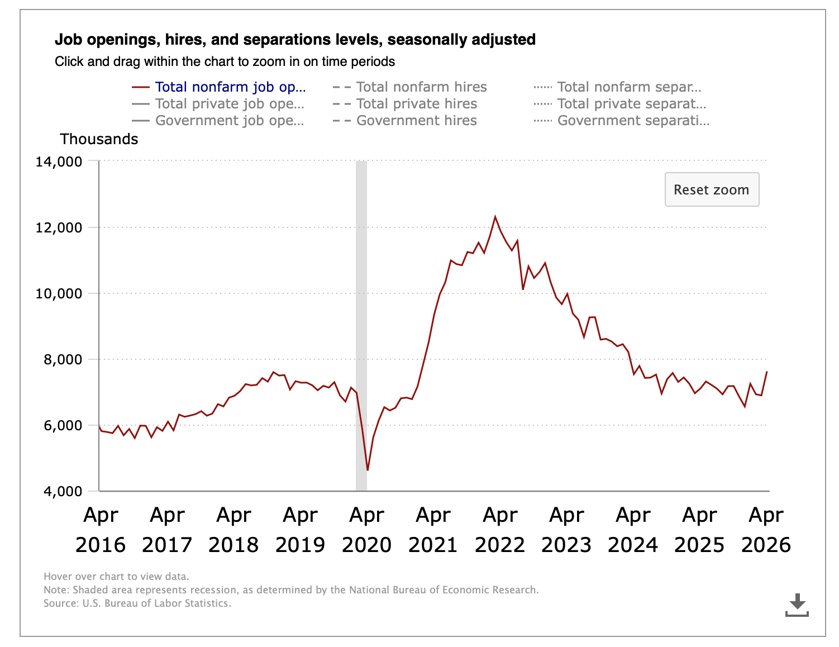
The Job Openings & Labor Turnover Survey (JOLTS) increased significantly to 7.6 million open jobs across the country as of the last business day in April. It was 6.9 million in March. More open jobs is a positive sign for the economy.
The 10-year chart below shows the downward trend continues in open jobs since the peak in March 2022.
The seasonally adjusted Total U.S. Unemployment Rate, U-6, decreased to 8.1% in May as compared to 8.2% in April. There were 6.9 million people unemployed in May, age 16 and older. In April, it was 6.8 million people unemployed. An increasing number of unemployed people looking for work is a good sign, as this happens when the economy is improving.
May Unemployment Rates by Education Level
Average hourly earnings of all employees on private nonfarm payrolls were up 3.4% in May compared to a year ago. It was up 3.6% in April.
| Less Than High School Diploma | 6.0% |
| High School Graduate, No College | 4.4% |
| Some College, Associate's Degree, or Skilled Trade Degree | 3.6% |
| Bachelor's Degree or Higher | 2.7% |
Gross Domestic Product (GDP)
The Bureau of Economic Analysis said the third and final estimate for GDP in the first quarter of 2026 increased at an annual real rate of 2.1%.
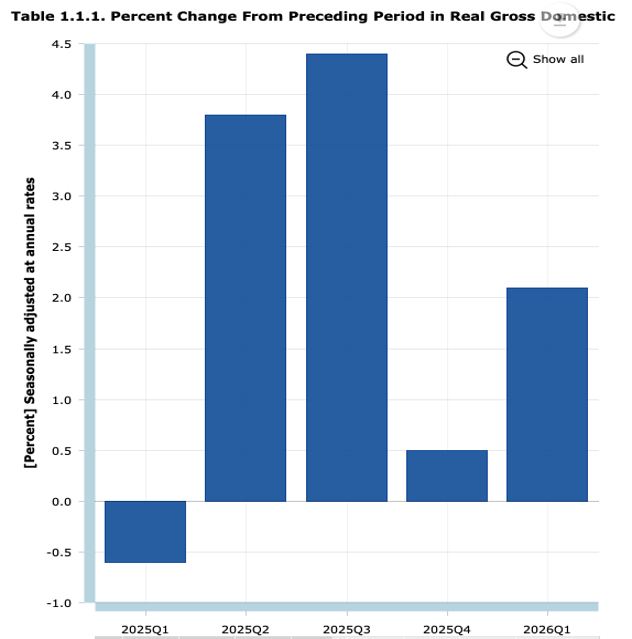
The increase in the first quarter GDP reflected an increase in exports, consumer spending, and government spending. These increases were offset by a decrease in imports. Imports are a subtraction in the GDP calculation. For the year 2025, GDP increased by 2.1%; in 2024, GDP increased by 2.8%, and it grew 2.9% in 2023.
Leading Economic Indicators (LEI) sponsored by The Conference Board
The LEI increased by 0.1% in May after increasing 0.2% in April. The Conference Board’s spokesperson said, “Despite the LEI expanding the last two months, the LEI’s six and twelve month growth rates are still negative, suggesting slower economic expansion ahead.”
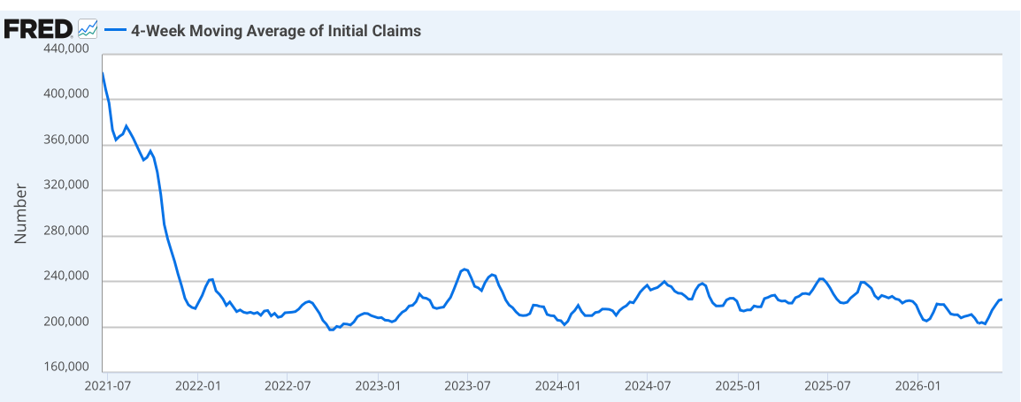
The 4-Week Moving Average of Initial Unemployment Claims
The week of June 25 found initial nation-wide unemployment claims came in at 224,250. See the 5-year chart below from the St. Louis Federal Reserve Bank. A reading of 350,000 to 375,000 weekly initial unemployment claims would indicate an approaching recession, but we are nowhere near those levels.
Labor Productivity (quarterly releases only)
Annualized and seasonally adjusted, nonfarm, labor productivity increased dismally by 0.3% in the first quarter of 2026, as released by the Bureau of Labor Statistics. For the year 2025, labor productivity increased at an annual rate of 2.5%. Labor productivity grew 2.3% in 2024 and an anemic 1.6% in 2023.
Inflation
Annual inflation increased to 4.1% in May as measured by the Personal Consumption Expenditures (PCE) price index. The revised annual April number was 3.8%. The annual core PCE price index, which excludes food and energy, increased slightly to 3.4% from a revised 3.3% in April.
University of Michigan Consumer Sentiment
Consumer sentiment in June increased to 49.5 compared to May’s revised 44.8. See the 10-year chart below.
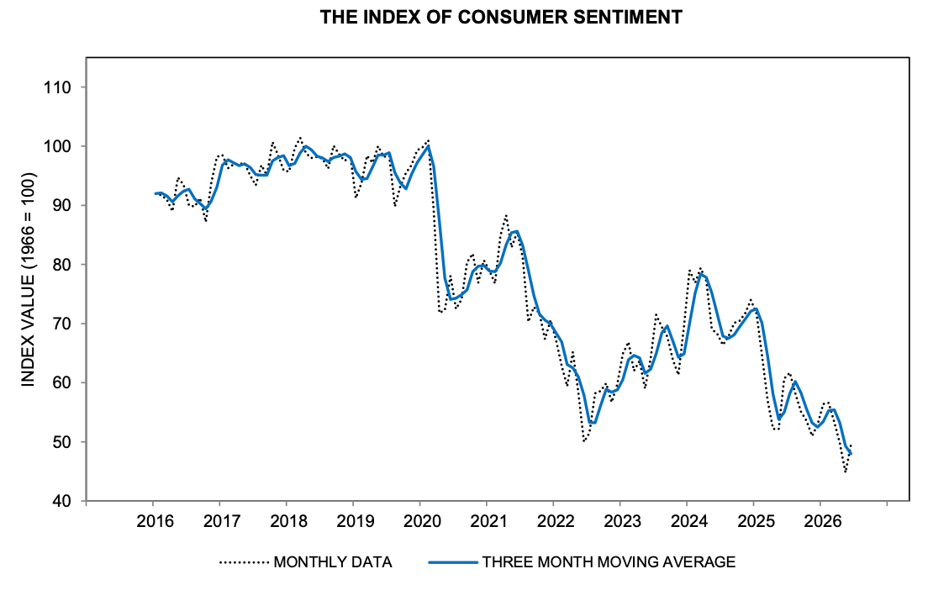
Expected business conditions over the next five years surged 16% as consumers’ worries over the long-term consequences of the Iran war appear to be easing.
Mortgage Rates and Average Existing Home Prices
As of June 30, 2026, the average 30-year fixed-rate mortgage had an interest rate of 6.54% compared to 6.53% last month. The average 15-year fixed-rate mortgage had an interest rate of 6.12%, compared to 5.87% in the previous month.
The median existing single-family home sale price increased in May 2026 to $429,300. That was up 1.3% compared to 12 months earlier. The seasonally adjusted annual rate of existing home sales was up 3.2% compared to a year earlier, according to the National Association of Realtors. The inventory of existing homes for sale increased by 0.6% compared to April 2025. This represents a 4.5-month supply of homes for sale.
The U.S. National Debt as Issued by the Treasury Department as of June 30, 2026, was:
$39,347,000,000,000.
Last month it was $39,192,000,000,000.
THE STOCK MARKET
Commentary
Since 1965, we have had two secular bear markets (a down market). A secular market is a 15 to 25-year market trend, while a cyclical market is a 2- to 5-year trend.
From 1966 to 1982, we had a high-inflation secular bear market. It consisted of both high inflation and high unemployment – stagflation. Some causes were the simultaneous spending on both the Vietnam War and the Johnson Administration’s war on poverty called The Great Society, and OPEC’s oil embargo on the US in 1973. Though the S&P 500 Index was roughly flat during this time, on an inflation-adjusted basis, the market lost 40%.
From 2000 to 2009, we had a low inflation secular bear market. It consisted of the Dot-Com Bubble from early 2000 to early 2003, the terrorist attack on the twin towers in New York in September 2001, and the Global Financial Crisis from 2007 into early 2009. During this time, the S&P 500 Index lost 55%.
OK, so what now? Well, it seems we are on borrowed time. The next secular bear market could be just around the corner or be another five years away. OK, what should we do? We should make sure we have all our insurance in place, have all our legal documents prepared, have an ample emergency fund, eliminate all bad debt, build cash reserves, shorten bond durations, reduce our allocation to aggressive growth funds and companies, and if still working, continue to save for retirement, daughter’s wedding, children’s college, etc.
Stock Market Valuation
On June 25, 2026, Tom Lee, co-founder of the market research firm Fundstrat Global Advisors, said on CNBC, “At the start of 2026, my S&P 500 Index prediction for the end of 2026 was 7,700. I have now raised that to 8,000 due to higher-than-expected corporate profits.”
The S&P 500 Index closed on June 30, 2026 at 7,499.36. Year to date, the Index, as per the exchange-traded fund VOO, is up 10.19%. This ETF includes dividends.
- Markets are volatile · Always consult your financial advisor before investing
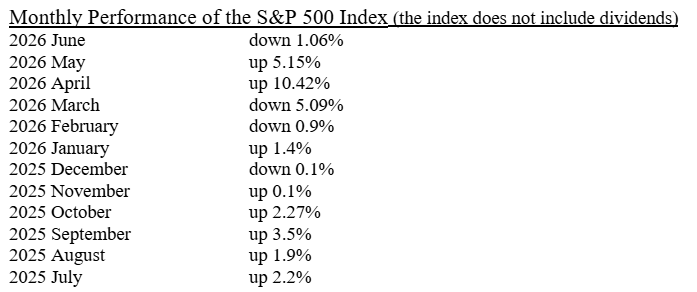
Recent Annual S&P 500 Performance As Per The Exchange Traded Fund, VOO
2025: +17.82%
2024:+24.98%
2023: +26.32%
2022: -18.19%
2021: +28.78%
2020: +18.29%
2019: +31.35%
Recommended Action for Your Stock Portfolio
In an article published on June 30, 2026, Mohamed El-Erian said, “Here are two things that worry me – stock market valuations and technical signals in some US stocks which look out of whack.”
“Valuations in the tech sector are stretched, even as the AI trade has cooled slightly. For example, the Shiller CAPE ratio – one valuation measure that reflects the market’s cyclically adjusted price-to-earnings ratio – is hovering near an all-time high. The tech stocks in the S&P 500 are up 15% for the year, outstripping the 8% gain in the broader index.”
El-Erian continued, “There is selling pressure creating technical indicators to be out of whack.” El-Erian said he believes some investors will soon conclude they have overinvested in AI as the craze for AI looks to be in a market bubble.”
“So, all of this could create a near-term “air pocket” or a quick drop in the tech sector.” El-Erian said, “There is going to be some data centers that are going to not be profitable because of overbuilding in this sector.”
Therefore, investors should reduce their exposure to the tech sector, which includes chip companies, chip equipment manufacturers, cybersecurity, AI companies, software companies in general, the Magnificent 7 stocks, and the newly minted SpaceX stock.
∙ Not FDIC Insured ∙ No Bank Guarantee ∙ May Lose Value
Financial Markets Vocabulary
What is the Phillips Curve?
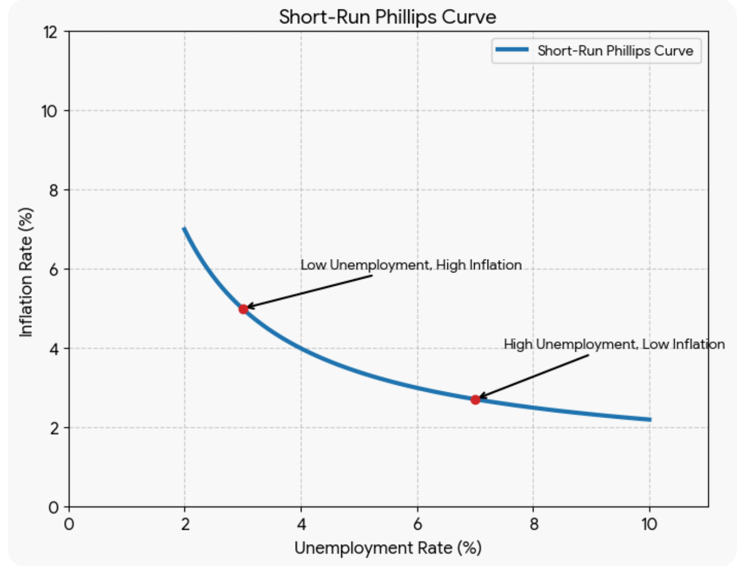
The Phillips Curve is an economic concept showing that inflation and unemployment have an inverse relationship. The theory states that lower unemployment leads to higher inflation, while higher unemployment leads to lower inflation.
Ideally, a government can move the whole curve downward through the following actions.
Supply Side Policies
1. Funding job training programs to reduce skill mismatches with the unemployed.
2. Deregulating industries to reduce red tape, which lowers overhead costs for businesses.
3. Investing in better infrastructure of roads, bridges, seaports, digital networks, updating the nation’s air traffic control system, updating the electrical grid, eliminating all lead water pipes, updating dams and levees, and certainly a more effective US Postal System.
4. Subsidizing Research and Development to boost worker productivity.
Establishing Policy Credibility
1. Promoting central bank independence.
2. Fiscal discipline will avoid massive, unexpected deficit spending to keep inflation under control.
3. Promote fair trade as a means to reach free trade.
4. Fair judicial and antitrust enforcement.
OK, Now What Do I Do?
Comments below are from Arthur Brooks, Harvard Professor, on CNBC, May 26, 2026, regarding how best to use Artificial Intelligence.
Brooks said, “Please remember these three things. First, our human desire is to be happy. We can achieve being happy if we pay attention to the things that matter to us the most. Those are:
- Faith
- Family
- Friends
- Our work serving others
The more we focus on these four things, the happier we will be.”
“Two, the left side of our brain handles analytical tasks, and the right side handles our emotions. And three, AI is going to ruin us if it makes us less human. We can turn that around and be winners if we use AI to make us more human. How can we use AI to accomplish that?”
“AI can make us happier if we use AI to handle some of our analytical investigating, thinking, and processing. This will give us more time to use the right side of our brain, our emotions, and focus on the four priorities above. This is how AI can make us more human.”
“But if we use AI to handle our emotions by talking to AI, letting AI become our friend, letting AI become our therapist (Oh no!), letting AI replace our religion, we will become less human.”
Brooks ends with this example: “If you are not interacting with your kids because you are looking at your phone, your phone is making you a lot worse off.
Of the 15 books Brooks has authored, his two best sellers are Build the Life You Want (2023) and From Strength to Strength (2022).
∙ Not insured by any bank or government ∙ Subject to risk & possible loss of principal
OUR FINANCIAL GOOD BOY THIS MONTH
Our “Good Boy” this month is trade schools!
Occasionally, Mark runs across a young person within a year of graduating high school. Mark asks, “What are your plans after graduating?” Occasionally a reply is grunted, “I dunno.”
Mark’s response goes something like this, “Well pilgrim, you have four broad choices. But first, if you need to get your head on straight, start here.
- Join the Peace Corps for 27 months and work overseas or join the AmeriCorps for 12 months and volunteer domestically. This could be the most productive personal growth opportunity a young person will ever experience.”
“Once you are able to focus on the rest of your life, you have these four choices:
- Go to college and take a variety of classes. Sooner or later, you will have an epiphany that lets you scream, ‘Hey, this is what I want to do!’ Finish college with at least a 2-year degree or a 4-year bachelor’s degree.
- Join the US military.
- Join your local police department or fire department.
- Go to a trade school.”
Let’s focus on the last idea above, trade schools. A good question becomes, what are the trades that have the most open jobs per year, and which ones are the highest paid? Hopefully this list will help some young people begin to think about their long-term career options.
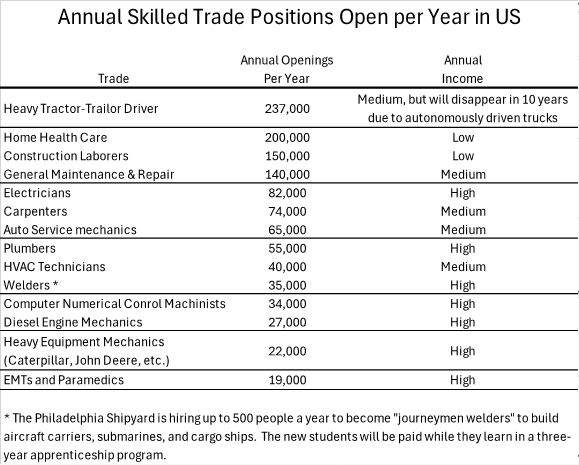
To parents and grandparents, how many young people can you show this list to?
• There is no guarantee by any bank or government • Subject to risk & possible loss of principal
The Bond Market
Commentary
On June 29, Mohamed El-Erian, Chief Economic Advisor, said on CNBC, “I would be shocked if we get a Federal Reserve interest rate hike in July and surprised if we get a rate hike this year.”
“So, let’s look at the drivers of our current inflation. The tariff driver is gone. The energy driver is more and more in the rearview mirror. So, we are going to hear the inflation shock is behind us. What remains will likely be a robust economy with inflation slightly above 2%.”
Recommended Action for Your Safest Money
This month, we are adding the category, ultra-short-term corporate bond funds, to our list of safe money options. Our investors’ safe money recommendations are listed below, in order, with the top line, PRPFX, representing potentially the highest returns, is reasonably safe but likely will have the highest volatility.
- Permanent Portfolio mutual fund, PRPFX, or gold or silver bullion.
- Short-term U.S. high-yield corporate junk bond funds.
- Short-term U.S. investment-grade corporate and securitized bond funds.
- Ultra-Short-term investment grade corporate bond funds.
- Bank or brokerage-house, high-yield savings or money market accounts, 4.1% min.
- FDIC bank or NCUA credit union, 1 to 4 yr, non-callable CDs, paying at least 4.1%.
- US Treasury Bills of 1 year, or Treasury Notes of 2, 3 or 4 years.
- U.S. Savings I-Bonds which have a max contribution of $10,000 per account per year, are tax-deferred for 30 years, do not drop in value as bonds drop in value when interest rates rise, interest is paid and compounded monthly, and the interest rate resets every six months based on inflation (the higher the inflation, the higher the interest rate).
The bottom option in the list above, U.S. Savings I-Bonds, is the most credit-safe and has the lowest volatility but potentially the lowest returns. These eight safe money ideas above are in order, with the highest volatility item on top and the lowest volatility item on the bottom. We recommend everyone spread their “safe money” over at least five of the eight ideas above.
Due to the low return of these investment products, investors should not put 100% or anything close to that in these products. These products are only for an investor’s safest money or perhaps 5% to 40% of an investor’s total portfolio, as based on the investor’s risk profile. These products are mostly credit safe, but they will not provide the growth or income needed to stay ahead of, or even keep up with, taxes plus inflation.
Past performance is not a guarantee of future results.
Pop Quiz Answer
How many companies can you name that are currently testing driverless taxis in the US?
Answer:
Here are the seven companies currently testing driverless taxis in the US.
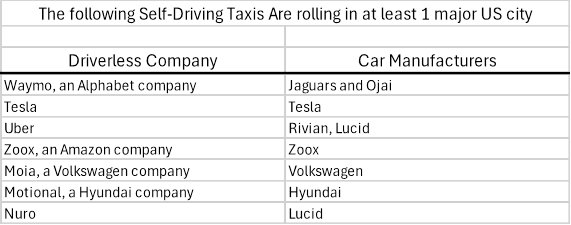
The number of rides carried out this year by a driverless taxi will exceed 35 million. Morgan Stanley estimates half of the US population will have access to at least one driverless taxi company within three years.