


Welcome to the October 2026 Newsletter. This month, we’re discussing the economy, employment, financial terminology, and more.
Summary
THE ECONOMY
On the good side, employment is in good shape as many people have jobs and are spending money, the economy is booming, and 2nd quarter’s annual rate of GDP growth was OK at 2.2%.
On the less-than-good side, oil prices are fluctuating between $90 and $110 a barrel, diesel prices are outrageous (which affects almost every consumer good), inflation is sticky, the federal deficit continues to grow, and the housing market is very depressed with “for sale” housing inventory increasing. Fortunately, there is no recession in sight. The economy is showing a yellow light.
THE STOCK MARKET
The stock market is not as robust as it was a few months ago. This is primarily due to sky-high Treasury yields. Valuations, as measured by the Shiller CAPE ratio, are above 41. Historically, valuations this high have only occurred near major market peaks, such as the Dot-Com crash from the first quarter of 2000 to the first quarter of 2003.
The breadth of the market is terrible, with only the AI stocks booming. 44% of the individual stocks in the S&P 500 have actually declined in 2026.
Finally, the Fed is likely to be hiking interest rates for quite some time to get inflation under control. The stock market is showing a yellow light.
Quote of the Day
Albert Einstein speaking to a Life Magazine reporter in early 1955, “Strive not to be a person of success, but rather a person of value.”

Pop Quiz
When a married couple enters senior status, 75% of the time, the man dies first. Even Billy-Ray knew that. So, when he turned 65, he ran down to a local estate planning attorney and had a new will prepared. Billy-Ray’s first wife was Junebug, but they divorced years ago. During those early years, Billy-Ray opened up a 401(k) with his employer and named Junebug as the account’s beneficiary. Now Billy-Ray’s current wife, Peaches, is named in his new will. The will states Peaches is to get everything upon his death (there are no kids).
Unfortunately, Bill-Ray is run over by his own farm tractor and dies. The Probate Court judge awards Junebug the proceeds of the 401(k), and Peaches gets everything else. Peaches has a hissy fit and sues Junebug. Who wins?
The answer to this month’s Pop Quiz is at the bottom of the newsletter.
The Economy
Employment
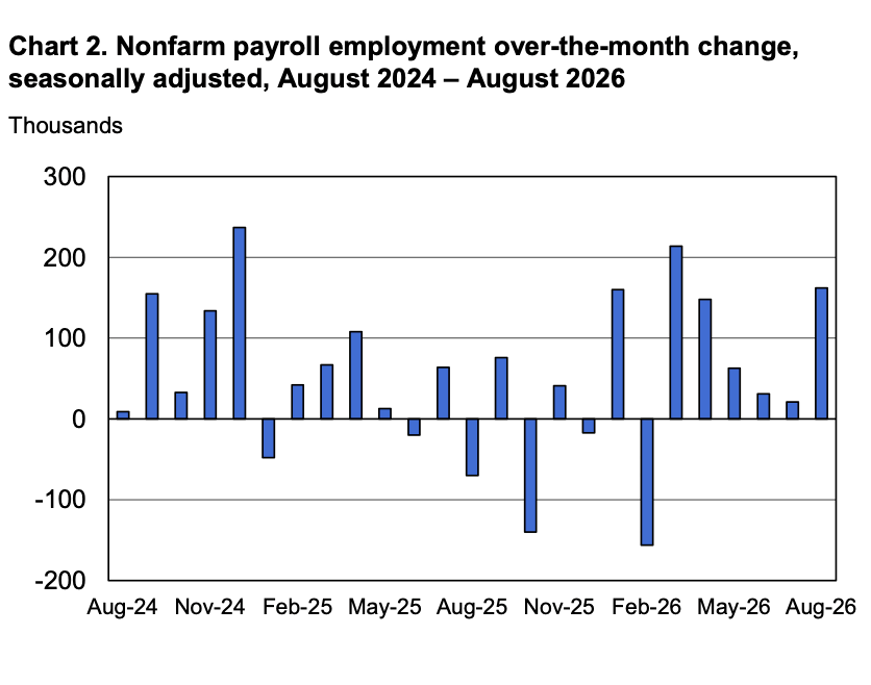
Total U.S. nonfarm payroll employment increased by 162,000 in August. The official unemployment rate, U-3, was unchanged at 4.1%. The June and July 2026 combined employment numbers were revised higher by 55,000 than previously reported. These numbers are a significant recovery from the previous three months of disappointing employment results.
Chart 1 below is based on the Bureau of Labor Statistics official unemployment rate, U-3.
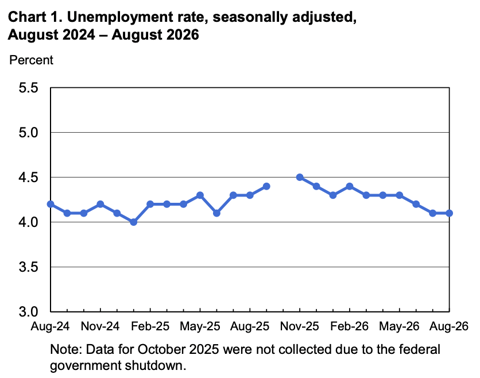
Chart 2 below shows the two-year trend of employment growth.
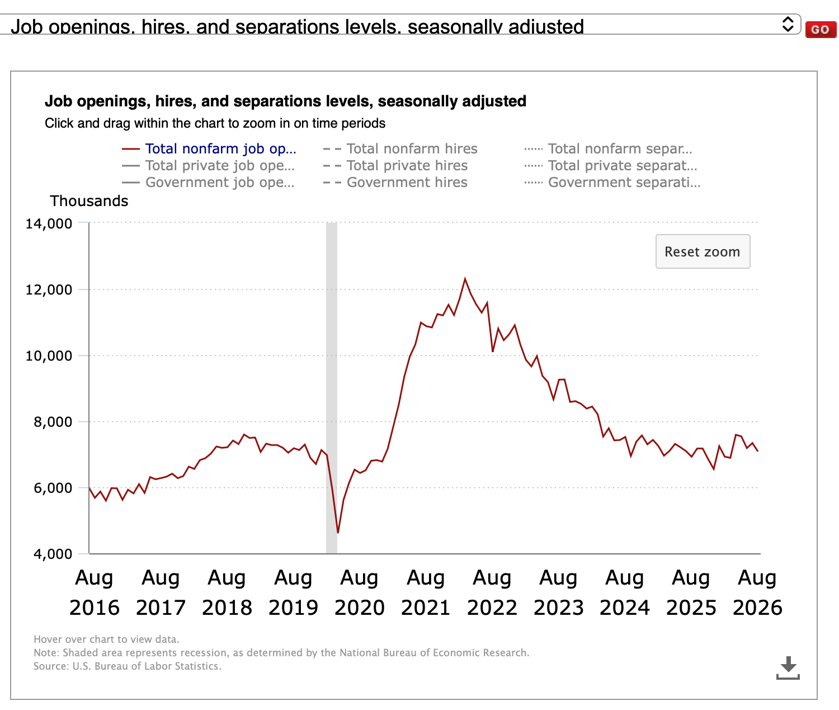
The Job Openings & Labor Turnover Survey (JOLTS) showed little change, with 7.1 million open jobs across the country as of August. It was 7.3 million in July.
The 10-year chart below shows the downward trend in open jobs since the peak in March 2022.
The seasonally adjusted Total U.S. Unemployment Rate, U-6, decreased to 7.7% in August compared to July. There were 7.4 million people unemployed in August, age 16 and older, the same as in July.
August Unemployment Rates by Education Level
Average hourly earnings of all employees on private nonfarm payrolls were up 3.1% in August compared to a year ago. It was up 3.2% in July.
| Less Than High School Diploma | 4.7% |
| High School Graduate, No College | 4.4% |
| Some College, Associate's Degree, or Skilled Trade Degree | 3.7% |
| Bachelor's Degree or Higher | 2.7% |
Gross Domestic Product (GDP)
The Bureau of Economic Analysis said the third and final estimate for GDP in the second quarter of 2026 increased at an annual real rate of 2.2%. GDP in the first quarter increased at 2.5%.
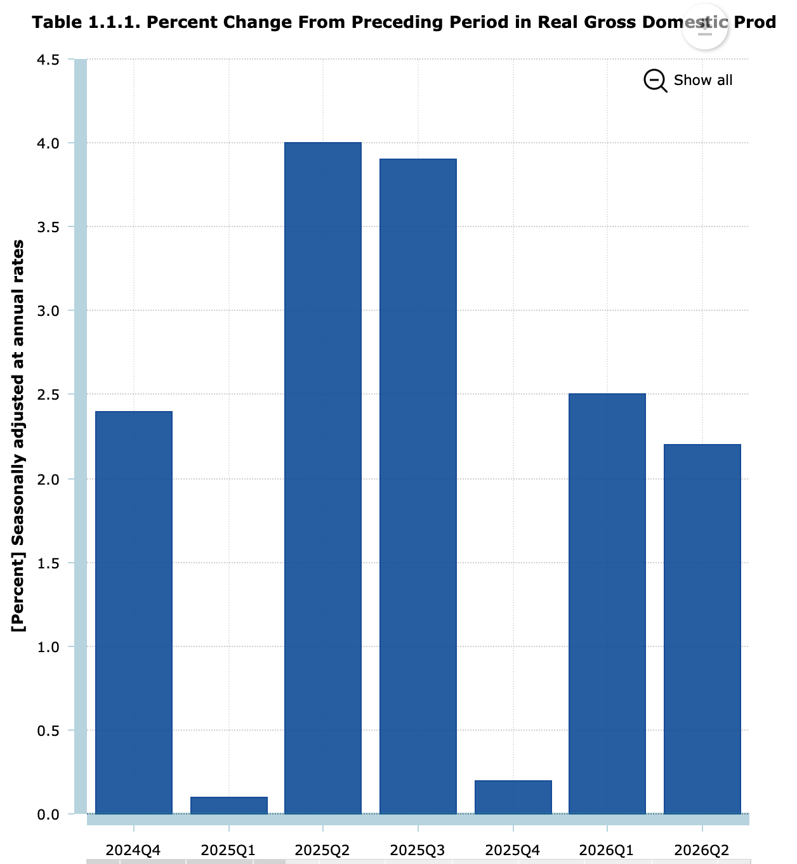
The increase in the second quarter GDP reflected an increase in consumer spending, investment, and exports.
Leading Economic Indicators (LEI) sponsored by The Conference Board
The LEI decreased by 0.1% in August after increasing 0.2% in July. The Conference Board’s spokesperson said, “Consumer expectations remain a significant strain on the index, along with a decline in building permits. The economy is still expanding, but growth is expected to slow.”
The 4-Week Moving Average of Initial Unemployment Claims – A Leading Economic Indicator
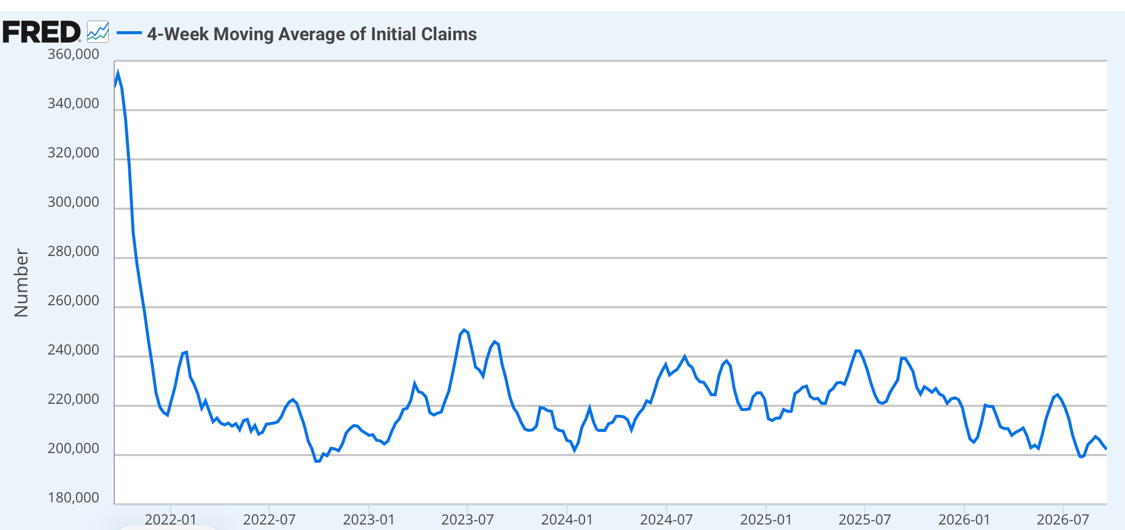
The week of Sept. 24 found initial nationwide unemployment claims had decreased slightly to 202,250. See the 5-year chart below from the St. Louis Federal Reserve Bank. A reading of 350,000 to 375,000 indicates an approaching recession, but we are nowhere near those levels.
Labor Productivity – Quarterly Releases Only, No Change This Month
Annualized and seasonally adjusted, nonfarm, labor productivity increased +1.4% in the second quarter of 2026, as released by the Bureau of Labor Statistics. With the first-quarter data being revised substantially down to 0.3%, the annualized rate of labor productivity for the first half of 2026 was a pitiful 0.85%. For the previous 10 years, annual labor productivity increased by an average of 1.9%.
Inflation
Annual inflation remained the same at 3.4% in August as measured by the Personal Consumption Expenditures (PCE) price index. The revised annual July number was also 3.4%. The annual core PCE price index, which excludes food and energy, remained the same at 3.0% in August, just as it was in July.
University of Michigan Consumer Sentiment
Consumer sentiment in September decreased to 48.1, compared to August’s revised 51.7. See the 10-year chart below.
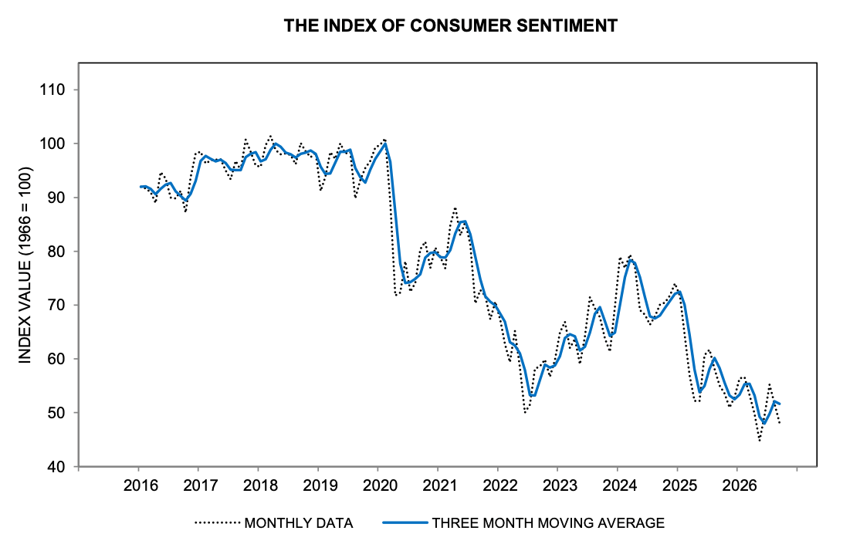
The short-run outlook for business conditions plunged amid renewed worries that elevated fuel prices and re-escalating trade disputes could pass through to the economy as a whole.
Mortgage Rates and Average Existing Home Prices
As of September 30, 2026, the average 30-year fixed-rate mortgage had an interest rate of 7.60%, compared to 6.87% last month. The average 15-year fixed-rate mortgage had an interest rate of 7.22%, compared to 6.38% in the previous month.
The existing single-family home median sale price decreased in August 2026 to $434,800 from $440,300 the previous month. But that was up 1.7% compared to 12 months earlier. The seasonally adjusted annual rate of existing home sales was down 1.1% compared to a year earlier, according to the National Association of Realtors. The inventory of existing homes for sale increased by 5.9% compared to August 2025. This represents a 4.9-month supply of homes for sale.
The U.S. National Debt as Issued by the Treasury Department as of September 30, 2026, was:
$40,225,000,000,000.
Last month it was $40,100,000,000,000.
THE STOCK MARKET
Stock Market Commentary
On September 28, 2026, Mohamed El Erian said on CNBC, “There are 2 dangerous features within the current stock market: volatility and interest rates that are tending to be higher for longer.”
El Erian continued, “A complicating factor is, as rates go up due to supply shortages, we should be addressing this with fiscal containment (lower federal spending). But since we have a do-nothing Congress, the Federal Reserve is left only with tightening monetary policy (raising interest rates).”
“This will result in:
- A stronger dollar
- And a headwind to stock market growth”
“As the dollar gets stronger and interest rates increase, the five industry segments that will be most negatively affected are utilities, real estate, commodities, auto manufacturing, and home building.”
Stock Market Valuation
On September 28, 2026, Ed Yardeni, President of Yardeni Research, said on CNBC he has lowered his year-end 2026 S&P 500 Index forecast from 8,400 to 7,900. He said this is due to high oil prices. He also said he now expects the S&P 500 to reach 8,400 by mid-year 2027 and 10,000 by the end of the decade.
The S&P 500 Index closed on September 30, 2026 at 7,651.54. Through September 30, the Index, as per the exchange-traded fund, VOO, is up 12.74%. This ETF includes dividends.
- Markets are volatile · Always consult your financial advisor before investing
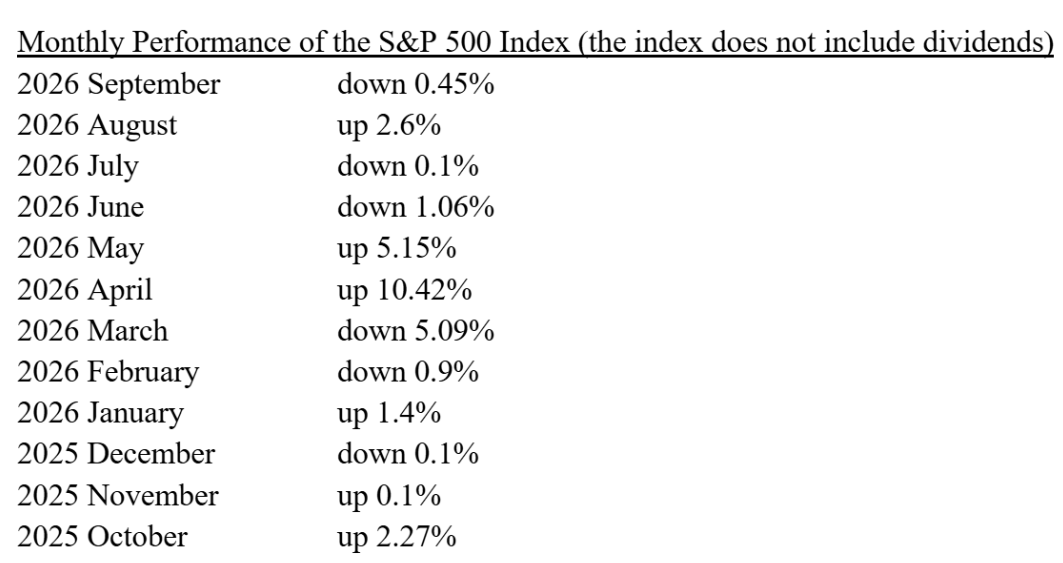
Annual S&P 500 Performance As Per The Exchange Traded Fund, VOO
2025: +17.82%
2024:+24.98%
2023: +26.32%
2022: -18.19%
2021: +28.78%
2020: +18.29%
2019: +31.35%
Recommended Action for Your Stock Portfolio
For stock market investors, one thing to keep an eye on is what has been and what the likely future “market disruptors” are.
In the past 25 years, what has disrupted our economy and stock market the most:
- The creation of the internet
- The Dot-Com Bubble
- The Great Recession, also called the Financial Crisis
- COVID
- Persistent inflation above 2%
What are likely to be some of the future disruptors?
- Clean Electrical Power (wind, solar, nuclear fission, small modular nuclear reactors, and eventually nuclear fusion)
- Artificial Intelligence
- Quantum Computing
- Cyber Security
- Robotics
- Space Travel
- Advanced battery technology
Some of these disruptors are highly speculative and may be 20 years away from being viable.
∙ Not FDIC Insured ∙ No Bank Guarantee ∙ May Lose Value
Financial Markets Vocabulary
Our country’s first Secretary of the Treasury was Alexander Hamilton. This month we will review what Hamilton said about excessive government debt.
Hamilton wrote, “Accumulating huge debts was perhaps the natural disease of all governments. Taken to the extreme, this will lead to a great and convulsive revolution.”
Hamilton continued, “It is the instinct of people to clamor for more government while also demanding no new taxes to pay for it. As a consequence, the public debt swells ‘till its magnitude becomes enormous and the burden on the people gradually increases ‘till the weight of the debt becomes intolerable. This future will eventually fill our hearts with pain, disgust, and fear as our streets fill with tears, blood, and human waste.”
Hamilton was the youngest member of George Washington’s cabinet, being only 32 years old when he first became Secretary of the Treasury. Although young, he might have been the wisest member of the cabinet.
OK, Now What Do I Do?
So you want to invest in big US companies. Well keep in mind the list changes. Here is the list of the 11 largest US companies in 2019.
- Apple
- Microsoft
- Alphabet
- Amazon
- Berkshire Hathaway
- JPMorgan Chase
- Johnson & Johnson
- Visa
- P&G
- Exxon Mobil
In 2026, the top 11 largest US companies are:
- Nvidia
- Apple
- Alphabet
- Microsoft
- Amazon
- Broadcom
- Space Exploration Technologies Corp.
- Meta
- Tesla
- Berkshire Hathaway
- Eli Lilly
• Not insured by any bank or government • Subject to risk & possible loss of principal
OUR FIRST FINANCIAL BAD BOY THIS MONTH
Our Bad Boy this month is our national debt of $40 trillion. So, let’s try and visualize $40 T.
An airline carryon bag can hold 10 Treasury “bricks”. A brick is 1,000 $100 bills wrapped tightly in plastic. Each brick is therefore $100,000 and a carryon bag with 10 bricks is holds $1 million.
Now to completely cover a football field, including both end zones, will require 25,000 airline carryon bags laid flat. 25,000 bags with $1 million each means the field is covered with $25 billion.
To visualize $40 trillion, we will need to cover 1,600 football fields with 25,000 carryon bags each with $1 million in each bag. $40 trillion is not a large amount of money but an obscene amount of money!
At the end of fiscal year 1999, our national debt was only $3.7 trillion – quite manageable as compared to $40 trillion.
Our conclusion is, we have exactly the government we have elected. Isn’t it time for term limits for member of Congress?
OUR SECOND FINANCIAL BAD BOY THIS MONTH
Thomas J. Lemmen is a former Schererville, Indiana, insurance agent who was sentenced to 70 months in federal prison on September 1, 2026, for executing a massive, multi-million-dollar life insurance fraud scheme.
He must also pay $1.6 million in restitution, and his sentence will be followed by 2 years of supervised release. His fraud involved a Ponzi-style scheme by writing more than 2,000 fraudulent life insurance policies.
The fraud continues in August 2026, as Megan Woods-Freeman was charged with 15 counts of forgery, one count of corrupt business practices, and one count of counterfeiting in a similar fraudulent insurance scheme. Her trial has not yet been scheduled.
• There is no guarantee by any bank or government. • Subject to risk & possible loss of principal.
The Bond Market
Commentary
Why are the yields of CDs, bonds, and money market accounts so high, and why are mortgage rates so high? There are three broad reasons.
- Our economy and most of the developed world’s economies are booming. Companies borrow more when their business is great. A booming economy by itself drives interest rates higher due to the higher supply of corporate credit.
- There is a very high amount of new Treasury bonds hitting the bond market every month. How do you get Treasury bond buyers to buy more Treasuries? The yields mostly go up. Our national debt in fiscal year 2026 has gone up by $2.17 trillion.
- There is also a huge new issuance of corporate bonds originated by the hyperscalers (Amazon, Microsoft, Alphabet, Meta, Oracle, and CoreWeave) as they build out AI and data centers.
The only way to get someone to buy all these new Treasury and corporate bonds is for the bond yields to go up.
Recommended Action for Your Safest Money
Our investor’s safe money recommendations are listed below, and in order, with the top line, PRPFX, representing potentially the highest returns, is reasonably safe, but likely will have the highest volatility.
- Permanent Portfolio mutual fund, PRPFX, or gold or silver bullion.
- Short-term, U.S. high-yield, corporate, junk bond funds, like FLHY.
- Short-term, U.S. investment-grade, corporate & securitized bond funds, like JPLD.
- Ultra-Short-term, U.S. investment-grade, corporate bond funds, like PULS.
- US Treasury Bills of 1 year, or Treasury Notes of 2, 3, 4 or 5 years, 4.5% to 5.05%.
- Bank high-yield savings or brokerage house money market accounts 3.75% min.
- FDIC bank or NCUA credit union, 1 to 5 yr, non-callable CDs, yielding 4.1 to 5.1%.
- U.S. Savings I-Bonds which have a max contribution of $10,000 per account per year, are tax deferred for 30 years, do not drop in value like bonds drop in value when interest rates rise, interest is paid and compounded monthly, and the interest rate resets every six months based on inflation (the higher the inflation, the higher the interest rate).
The bottom option in the list above, U.S. Savings I-Bonds, is the most credit-safe and has the lowest volatility but potentially the lowest returns. These eight safe money ideas above are in order, with the highest volatility item on top and the lowest volatility item on the bottom. We recommend everyone spread their “safe money” over at least five of the eight ideas above.
Due to the low return of these vehicles, investors should not put 100% or anything close to that in these products. These products are only for an investor’s safest money or perhaps 5% to 40% of an investor’s total portfolio, based on the investor’s risk profile. These products are mostly credit safe, but they will not provide the growth or income needed to stay ahead of, or even keep up with, taxes plus inflation.
Past performance is not a guarantee of future results.
Pop Quiz Answer
When a married couple enters senior status, 75% of the time, the man dies first. Even Billy-Ray knew that. So, when he turned 65, he ran down to a local estate planning attorney and had a new will prepared. Billy-Ray’s first wife was Junebug, but they divorced years ago. During those early years, Billy-Ray opened up a 401K with his employer and named Junebug as the account’s beneficiary. Now Billy-Ray’s current wife, Peaches, is named in his new will. The will states Peaches is to get everything upon his death (there are no kids).
Unfortunately, Bill-Ray is run over by his own farm tractor and dies. The Probate Court judge awards Junebug the proceeds of the 401(k), and Peaches gets everything else. Peaches has a hissy fit and sues Junebug. Who wins?
Answer:
Junebug gets to keep the 401(k) proceeds. A signed written beneficiary document for a retirement account is a legally binding contract that completely overrides anything written in a will or trust! Always hire an in-state lawyer who practices estate planning to assist with the complete estate planning process. Do it NOW!
Estate planning must always include a thorough review of all accounts containing a named beneficiary. Key assets to always keep in mind during this process are real estate, cars and trucks, bank accounts, brokerage accounts, life insurance, annuities, retirement accounts such as 401(k)s and IRA’s, education savings accounts, health savings accounts, savings accounts at the US Treasury, and Certificates of Deposit.
Life (and death) is absolutely more complicated today than in 1960. This is why your grandparents did not need an estate planning attorney, but you do today. The estate planning attorney will prepare the five documents below that everyone over the age of 18 should have. For a married couple, this is 10 documents total.
- Will
- Durable Power of Attorney
- Health Care Power of Attorney
- Living Will, also called Health Care Directive
- HIPAA Release