


Welcome to the June 2026 Newsletter. This month, we’re discussing the economy, employment, financial terminology, and more.
Summary
Mohamed El-Erian of the Wharton School said in mid-May, “The US stock market has decoupled from the US economy because we have three things are going on.”
“One, is the dominance of technology. Tech is insensitive to everything outside of tech (such as war and the price of oil). The second thing is the conditioning of investors. We have been conditioned to ignore geopolitical shocks. The third item is the US has continued to outperform the rest of the world both economically and in the stock market.”
“Why? At least in part because in the rest of the world, higher inflation has caused demand destruction. In the US, we have not yet seen demand destruction, but we will if core inflation takes off.”
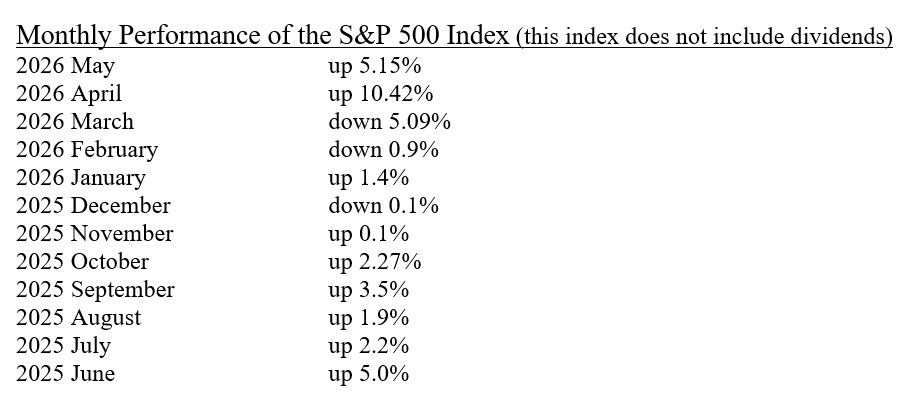
The S&P 500 Index set another all-time closing high on May 29, 2026, at 7,580.06. On April 30, 2026, the index closed at 7,209.01. This represented an increase of 5.1% during May after an increase of 10.4% in April. It is not wise to try and predict the stock market in the short-term, but we are optimistic for both the economy and the stock market in the intermediate-term and long-term.
Quote of the Day
During a “Fireside chat” radio address on September 11, 1941 (approximately 3 months prior to the Japanese attack on Pearl Harbor), President Franklin Roosevelt spoke to the American people. During the address, President Roosevelt spoke of a recent military incident near Iceland – a German U-boat attacked the destroyer USS Greer. The President said, “When you see a rattlesnake (Nazi Germany) posed to strike, you do not wait until he has struck before you crush him.”
The USS Greer suffered no damage from the two torpedoes the U-boat fired at it. This attack led President Roosevelt to declare a “shoot-on-sight” policy against German ships in American-defended waters. Thank you, President Roosevelt!
No one knew at that time, but the President was not only offering wise advice towards current American enemies but also future ones. Some of our current aggressors have chanted with great energy and forcefulness, “Death to America”, labeled us the “Great Satan”, and targeted all American military service members as “terrorists and legitimate targets of war”. What is the one good thing about a rattlesnake – it rattles before it strikes.

Pop Quiz
Where is the following quote written?
“Proclaim liberty throughout the land to all its inhabitants.”
The answer to this month’s Pop Quiz is at the bottom of the newsletter.
The Economy
Employment
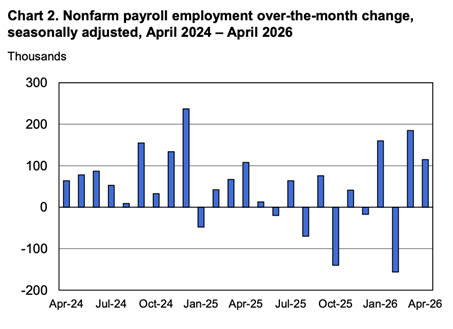
Total U.S. nonfarm payroll employment increased by 115,000 in April. The official unemployment rate, U-3, was unchanged at 4.3%. The February and March 2026 combined employment numbers were revised lower by 16,000 than previously reported.
Chart 1 below is based on the Bureau of Labor Statistics' official unemployment rate, U-3.
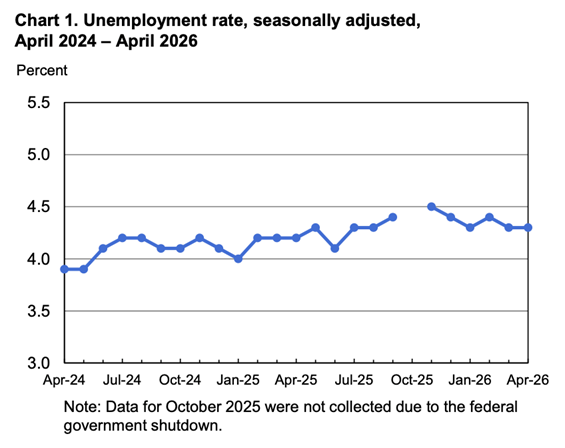
Chart 2 below shows the two-year trend of employment growth.
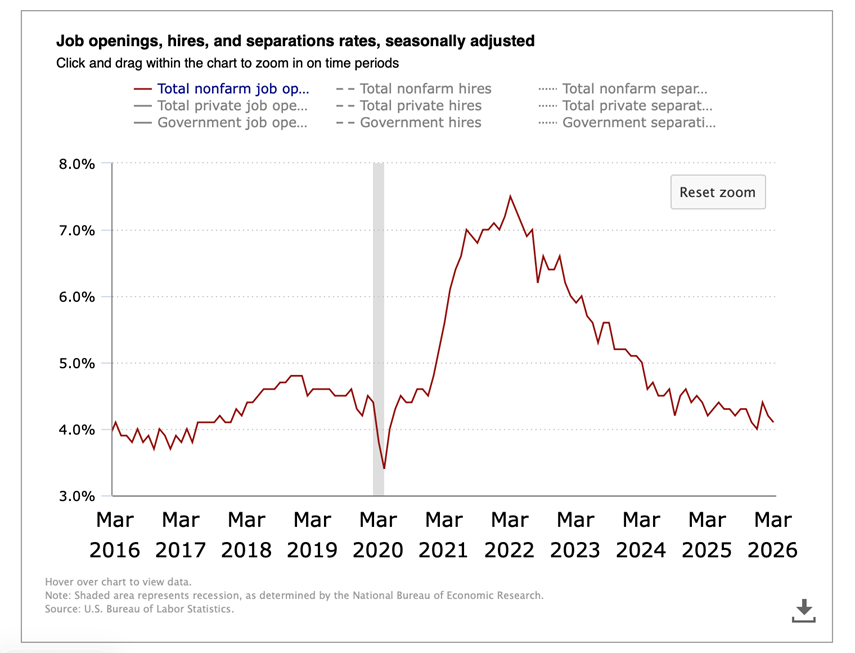
The Job Openings & Labor Turnover Survey (JOLTS) was unchanged at 6.9 million open jobs across the country as of the last business day in March. It was 7.2 million in January.
The 10-year chart below shows that the downward trend in open jobs continues since the peak in March 2022.
The seasonally adjusted Total U.S. Unemployment Rate, U-6, increased to 8.2% in April as compared to 8.0% in March. There were 6.8 million people unemployed in April, age 16 and older. In March, it was 7.3 million people unemployed.
April Unemployment Rates by Education Level
Average hourly earnings of all employees on private nonfarm payrolls were up 3.6% in April compared to a year ago. It was 3.5% in March.
| Less Than High School Diploma | 6.4% |
| High School Graduate, No College | 4.7% |
| Some College, Associate's Degree, or Skilled Trade Degree | 3.2% |
| Bachelor's Degree or Higher | 2.8% |
Gross Domestic Product (GDP)
The Bureau of Economic Analysis said the second GDP estimate for the first quarter of 2026 increased at an annual real rate of 1.6%.
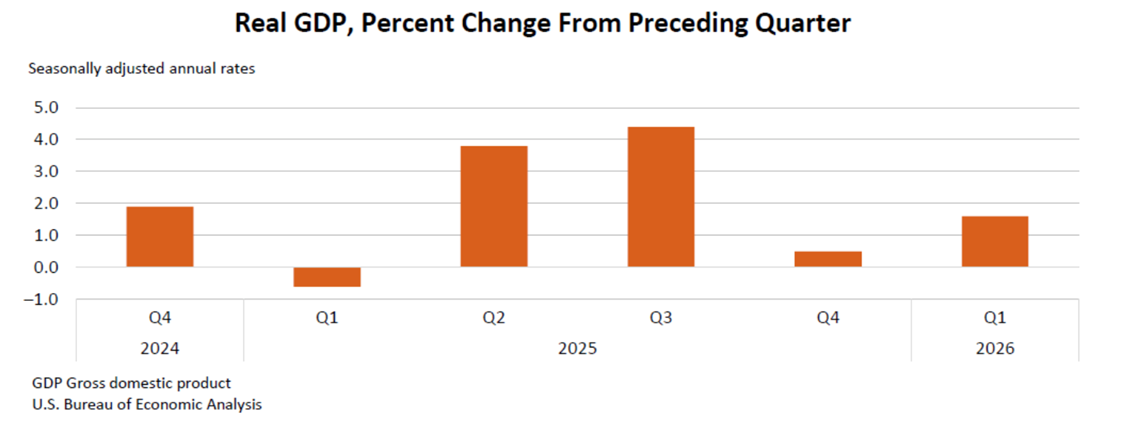
The increase in the first quarter GDP reflected an increase in exports, consumer spending, and government spending. These increases were offset by increases in imports, which is a subtraction in the GDP calculation. For the year 2025, GDP increased by 2.1%; in 2024 GDP increased by 2.8%, and grew 2.9% in 2023.
Leading Economic Indicators (LEI) sponsored by The Conference Board
The LEI increaed by 0.1% in April after reversing the March decrease of 0.6%. The Conference Board’s spokesperson said, “The LEI increased in two of the past three months, showing strong investment in AI infrastructure, data centers, and energy production.”
The 4-Week Moving Average of Initial Unemployment Claims
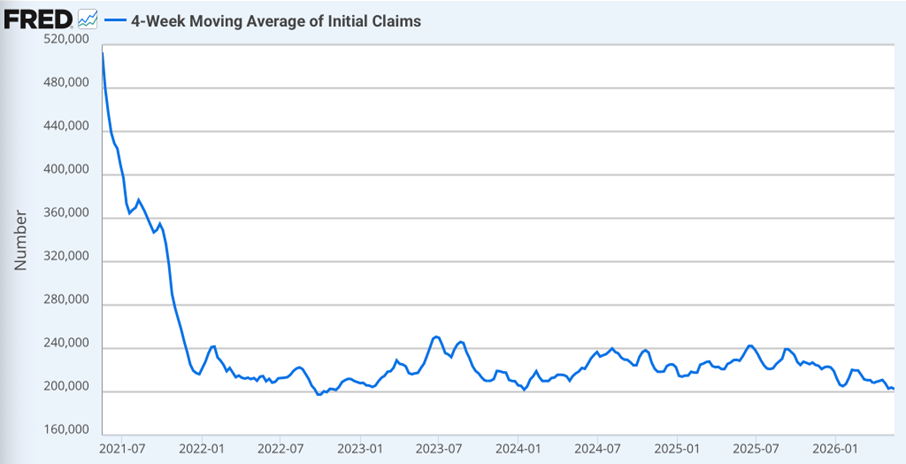
The week of May 16 found initial nationwide unemployment claims came in at 202,500. See the 5-year chart below from the St. Louis Federal Reserve Bank. The higher the graph, the more likely a recession is pending. A reading of 350,000 to 375,000 weekly initial unemployment claims would indicate an approaching recession, but we are nowhere near those levels.
Labor Productivity (quarterly releases only)
Annualized and seasonally adjusted, nonfarm, labor productivity increased by 0.8% in the first quarter of 2026, as released by the Bureau of Labor Statistics. For the year 2025, labor productivity increased at an annual rate of 2.5%. Labor productivity grew 2.3% in 2024 and an anemic 1.6% in 2023.
Inflation
Annual inflation remained the same at 2.1% as measured by the Personal Consumption Expenditures (PCE) price index for April and March. The revised annual February number was 2.6%. The annual core PCE price index, which excludes food and energy, remained the same in April and March at 2.4%, from a revised 3.0% in February.
University of Michigan Consumer Sentiment
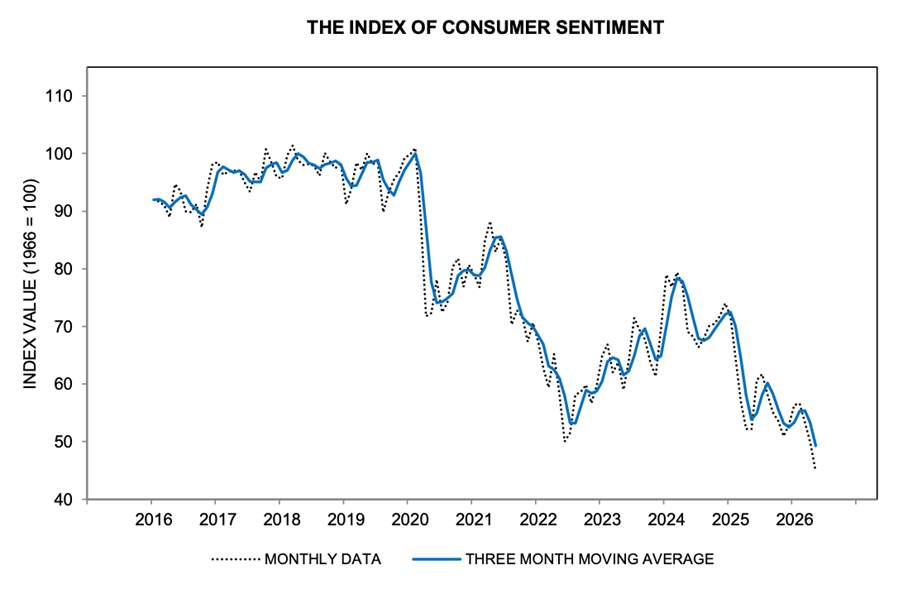
Consumer sentiment in May decreased to 44.8 compared to April’s revised 49.8. See the 10-year chart below.
Mortgage Rates and Average Existing Home Prices
As of May 31, 2026, the average 30-year fixed-rate mortgage had an interest rate of 6.53% compared to 6.45% last month. The average 15-year fixed-rate mortgage had an interest rate of 5.87%, compared to 6.01% in the previous month.
The median existing single-family home sale price increased in April 2026 to $417,700. That was up 0.9% compared to 12 months earlier. The seasonally adjusted annual rate of existing home sales was unchanged compared to a year earlier, according to the National Association of Realtors. The inventory of existing homes for sale increased by 1.4% compared to April 2025. This represents only a 4.4-month supply of homes for sale.
The U.S. National Debt as Issued by the Treasury Department as of May 31, 2026, was:
$39,192,000,000,000.
Last month it was $39,184,000,000,000.
Important Dates in June
THE STOCK MARKET
Commentary
The two big stock market questions today are, “Are we in a bubble?” and “Can anyone provide an answer to that question that is more than speculation?”
The answers are no to the first question, and yes to the second. An insightful opinion comes from Owen Lamont, an economist and portfolio manager at Acadian Asset Management in Boston. Lamont has written extensively about market extremes. Lamont says there are four prerequisites to a stock market bubble. They are:
Overvaluation of stock prices and PE ratios. The ultimate sign of a bubble is performance-chasing behavior. What has been seen recently is the opposite: Individual investors have been buying stocks on bad news. Lamont said, “A bubble occurs when investors are buying the rip (when stock prices are moving up), not buying the dip” (when stock prices are moving down). Conclusion: no bubble today.
Inflows defined as a surge of new retail buyers. This occurs when the most conservative investor uses his cash or sells his bonds to buy into the stock market. For example, Mark’s father asked Mark in December 1999, “Son, do you think I should put some money into the stock market?” And now remember the Dot Com Bubble started in January 2000. My dad was the perfect contrarian indicator for the stock market. Overall, the average daily volume of the stock market in May 2026 is up 16.8% year over year. The dollar volume is up 50% over January 2025. Conclusion: we are not yet in bubble territory but getting closer.
Strong Participant Psychology suggesting even though a market is at a high, it will continue to go higher. This was the case with the price of bitcoin. In October 2025, the price of bitcoin hit $126,000. Its supporters continued to tout bitcoin’s advantages as opposed to criticizing their detractors. Conclusion: Today’s stock market sentiment does not suggest we are in a bubble.
A Tidal Wave of New Stock Issuance when private companies go public and issue stock for the first time. Today we do not have a significant level of new stock issuance, but three gigantic private companies are planning to go public later this year. Those companies are SpaceX, Anthropic, and OpenAI. Conclusion: no bubble today, but the year is not yet over. The apple cart might be upset within a few months following the vast quantity of new stock from these three companies. Lamont said this is the greatest threat today of a stock market bubble on the edge of bursting.
Stock Market Valuation
On May 11, Ed Yardeni, President of Yardeni Research based in Glen Head, NY, said, “My 2025 year-end target for the S&P 500 Index was 7,000. We ended 2025 at 6,645. My previous 2026 year-end target for the S&P 500 Index was 7,700. I now have increased that target to 8,250. Don’t underestimate the resiliency of the US economy and the US consumer. Some analysts are now estimating 2026 corporate earnings to be 23% higher than in 2025. That is an extraordinary increase!”
“What is leading earnings to increase?
- We have an aggressive capital expense program going on with AI companies.
- We have a substantial increase in productivity.
- The One Big Beautiful Bill permanently restores 100% bonus depreciation for eligible capital expenses. Previously, the limit for 2026 was 20%.
- Supply chains are moving back to the US.”
We also have similar comments from Stephanie Link, Chief Investment Strategist and Portfolio Manager at Hightower Advisors based in Chicago and New York. On May 11, Link said, “The following is driving today’s stock market:
- The Atlanta Fed GDP Tracker is at 3.7%.
- The labor market is in good shape.
- We are in the middle of an exciting corporate capital expenditure cycle.
- Productivity is increasing.
- We have above-trend growth in corporate profits.”
“The results are significant stock price growth.”
The S&P 500 Index closed on May 29, 2026 at 7,580.06. Year to date, the Index, as per the exchange-traded fund VOO, is up 11.26%. This fund includes dividends.
- Markets are volatile · Always consult your financial advisor before investing
Recent Annual S&P 500 Performance As Per The Exchange Traded Fund, VOO
2025: +17.82%
2024:+24.98%
2023: +26.32%
2022: -18.19%
2021: +28.78%
2020: +18.29%
2019: +31.35%
Recommended Action for Your Stock Portfolio
Lately, we have not been putting client money into small-cap stocks due to this sector being so highly volatile, but it can be argued that for diversification reasons, an investor should put 5% or so of their stock portfolio into US small caps. If so, what is the best way to do that?
Keep in mind that if a stock analyst is deciding which large-cap stocks to invest in, there are reams of data published monthly on those stocks. But there is very little published on small cap stocks. So, a fund company has to do all their own analysis on small cap stocks if that is where they want to invest. And this is why the annual expense ratio of small cap funds tends to be higher than the expense ratio of large cap funds.
One way to invest in small cap stocks and keep the annual expense ratio low is to invest in a small cap index fund. OK, which index should an investor focus on? The most commonly quoted small cap index is the Russell 2000. What is important to know is most of the companies in the Russell 2000 Index are unprofitable! So, we don’t want to invest there!
Note the Vanguard fund, VTWO, which follows the Russell 2000, is rated 3 Star Gold by Morningstar. This fund’s 10-year average annual return has been 11.38%. Its 10-year risk is rated Above Average (Bad), and its 10-year return is rated only Average.
The better small cap index is the S&P 600 Small Cap Index. Most of its small companies are profitable. A good index fund in this category is the iShares US Small Cap Equity ETF, SMLF. It is rated 5 Star Gold by Morningstar with a 10-year average annual return of 12.48%. Its 10-year risk is rated Below Average (Yeah), and its 10-year return is rated Above Average (Yeah).
Go SMLF! Remember, no more than 10% in this fund and more likely 5%.
∙ Not FDIC Insured ∙ No Bank Guarantee ∙ May Lose Value
Financial Markets Vocabulary
What is the Laffer Curve?
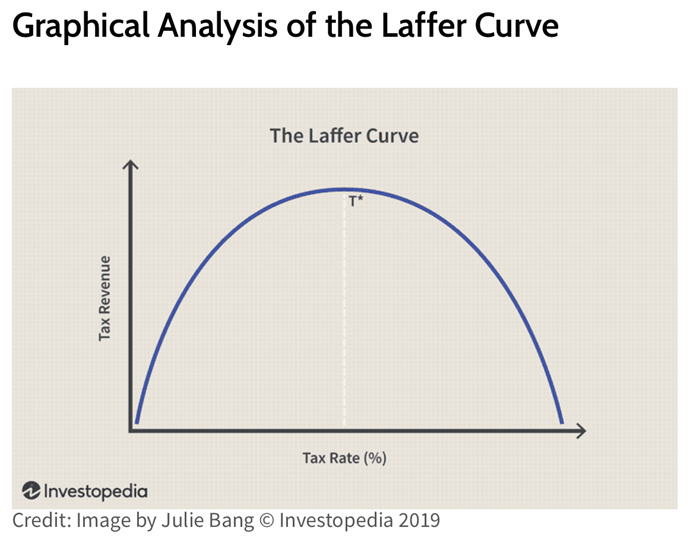
In 1974, American economist Arthur Laffer developed a bell-shaped curve that plotted the relationship between changes in the government’s tax rate and tax receipts. The analysis became known as the Laffer Curve.
The analysis begins with the statement: tax receipts will be zero with both a 0% tax rate and a 100% tax rate. Note, a population will cease all production when they have a zero incentive to produce with a 100% tax rate. The analysis also suggests there is a tax rate between 0% and 100% that produces the maximum tax revenue.
If a society is on the left-hand side of the peak revenue, tax revenue can be increased by increasing the tax rate. If, on the other hand, a society is on the right-hand side of peak revenue, tax revenue can be increased only by cutting the tax rate.
Using the Laffer Curve analysis and the belief that federal income tax rates were to the right of peak revenue, President Reagan and Congress dramatically cut income tax rates in order to increase federal government tax receipts. The plan worked as total tax revenue increased during President Reagan’s term from $517 billion in 1980 to $909 billion in 1988.
OK, Now What Do I Do?
The last significant economic downturn we’ve had was 2022, with the stock market down 18% on the year. More and more people are now saying, “Well, it’s about time for a 20% stock market correction and perhaps even a recession.” Remember, WE WILL ALWAYS HAVE THE NEXT RECESSION. YES, ALWAYS! But that does not mean we should hide under a rock.
No one can reliably predict when the next recession will begin or end. Therefore, remember the Boy Scout motto: “Be Prepared!” Knowing another recession is always coming, how should we get ready?
- Spend less than you make! This is always step one.
- Permanently pay off all bad debt. All debt is bad debt except a conventional, fixed-rate, first mortgage on your primary residence.
- Bump up your emergency fund to a full six months of living expenses.
- Make sure all your insurance is in place (life, medical, auto, home or renters, umbrella liability, ID theft protection, long-term disability income up to age 55 to 60, and then cancel the disability income insurance and buy long-term care insurance after age 55 to 60.
- Increase retirement savings to 15% of the family’s gross income.
- Make sure you, and your spouse if married, each have the following five key legal documents in place as prepared for you by an estate planning attorney in your state:
- Will
- Durable power of attorney
- Health care power of attorney
- Living Will, also called a health care directive, and
- HIPAA waiver
∙ Not insured by any bank or government ∙ Subject to risk & possible loss of principal
OUR FINANCIAL GOOD BOY THIS MONTH
How Sweden Learned to Love Capitalism
The Wall Street Journal, May 13, 2026, page A1
For decades, Sweden was shorthand for the brand of high-tax, high-spend government that managed people’s lives from cradle to grave through state-run hospitals, schools and special-needs care facilities.
No longer. With little fanfare, this Nordic country of 11 million has embraced capitalism. For example, one in three public high schools are now privately run, up from 20% in 2011.
The capitalist makeover has allowed Sweden to do what few industrialized countries have managed in recent years: shrink the size of the country’s budget. That has enabled the government to sharply lower taxes, which has sparked a surge in entrepreneurship and economic growth.
Stefan Folster, an economist and former Finance Ministry official, argues the vast majority of Swedes have benefited from the reforms. Household inflation-adjusted income has doubled on average since the 1990’s, after stagnating during the ‘70s and ‘80s under high taxation.
The Swedish stock market has seen more than 500 initial public offerings over the 10 years through 2024, more than Germany, France, the Netherlands, and Spain combined!
Our conclusion at Lorenz Financial, when a society is seduced with freedom, low taxes, and opportunities to better themselves through hard work and innovation, families and societies thrive as the country’s economic pie grows larger and larger. Under communism, each country’s economic pie tends to get smaller. Clear examples are Russia, North Korea, Democratic Kampuchea (Cambodia), and Cuba.
• There is no guarantee by any bank or government • Subject to risk & possible loss of principal
The Bond Market
Commentary
At the White House on May 22, 2026, Kevin Warsh was sworn in by Supreme Court Associate Justice Clarence Thomas as the new Federal Reserve Chair.
Afterwards, Chair Warsh pledged to lead a “reform-oriented Federal Reserve” focused on lower inflation, economic growth, and institutional independence.
Warsh emphasized the central bank’s mission remains price stability and maximum employment. He noted that when the Fed pursues its goals with “wisdom, clarity, independence, and resolve,” it yields lower inflation, stronger growth, and higher real take-home pay.
As with all past Fed Chairs, Warsh is both a Fed Governor with a 14-year term while his term of office as Fed Chair is 4 years. All terms of office can be renewed.
Recommended Action for Your Safest Money
Our investor’s safest money recommendations are now listed below and in order with the top line, PRPFX, representing potentially the highest returns, is reasonably safe, but likely will have the highest volatility. This month we are also adding short-term US corporate high-yield (junk bond) funds as an option for PART of a family’s safe money.
- Permanent Portfolio mutual fund, PRPFX, or gold or silver bullion.
- Short-term U.S. high-yield corporate bond funds.
- Short-term U.S. investment-grade corporate and securitized bond funds.
- FDIC bank or NCUA credit union, 1 to 4 yr CDs, paying at least 4.0%.
- Bank or brokerage-house, high-yield savings or money market accounts, 4.0% min.
- US Treasury Bills of 1 year, or Treasury Notes of 2, 3 or 4 years.
- U.S. Savings I-Bonds which have a max contribution of $10,000 per account per year, are tax deferred for 30 years, do not drop in value like bonds drop in value when interest rates rise, interest is paid and compounded monthly, and the interest rate resets every six months based on inflation (the higher the inflation, the higher the interest rate).
The bottom option in the list above, U.S. Savings I-Bonds, is the most credit-safe and has the lowest volatility but potentially the lowest returns. These seven safe money ideas above are in order, with the highest volatility item on top and the lowest volatility item on the bottom. We recommend everyone spread their “safe money” over at least five of the seven ideas above.
Due to the low return of these investment products, investors should not put 100%, or anything close to that, in these products. These products are only for an investor’s safest money or perhaps 5% to 40% of an investor’s total portfolio, as based on the investor’s risk profile. These products are mostly credit-safe, but they will not provide the growth or income needed to stay ahead of, or even keep up with, taxes plus inflation.
Past performance is not a guarantee of future results.
Pop Quiz Answer
Where is the following quote written? “Proclaim liberty throughout the land to all its inhabitants.”
Answer:
The above quote is written in two places. First, in the Old Testament, Leviticus 25:10.
Second, it is cast into the US Liberty Bell located within the Independence National Historical Park in Philadelphia, Pennsylvania.